
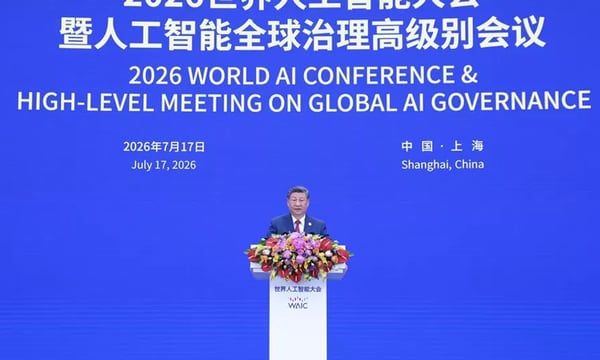
China’s President Xi Jinping delivers opening remarks at the 2026 World AI Conference in Shanghai, China, July 17, 2026.
Xi Jinping, president of China and general secretary of the Chinese Communist Party (CCP), traveled to Shanghai in mid-July. Of his several missions in Shanghai, none was more important than his opening speech to the World Artificial Intelligence Conference.
Breaking from the norm established since the first World Artificial Intelligence Conference was held in Shanghai in 2018, Xi himself, rather than a leader from the inner circles of the CCP, took the helm on July 17 and opened the conference with his thoughts. And his speech left no doubt that he has decided to take a leading role in the development of AI.
Xi’s speech addressed the attendees at the conference, but his real audience was the international community, and of course the United States, China’s chief competitor in AI development. Surprisingly, Xi began his speech by giving credit to the foreign sources that initiated the study and development of AI.
“Seventy years ago,” Xi told the assembly, “a group of young scholars proposed the concept of artificial intelligence (AI) for the first time at the Dartmouth Workshop in New Hampshire of the United States.”
The reference to the foreign, indeed American, creators who were the progenitors of AI is an uncharacteristic acknowledgement for a Chinese leader to make.
“In the course of history,” Xi said, “the invention of the steam engine heralded the industrial civilization, the widespread access to electricity brightened up modern society, and the birth of the internet brought the entire world together.”
All of these inventions originated in Europe or the United States.
While lauding the potential of AI, Xi did not shy away from the reality that much is still unknown about AI’s capabilities:
We human beings must answer the questions posed by our times: How to get along with thinking machines? How to ensure security when algorithm is part of decision-making? How to tackle ethical challenges by technologies through adaptive governance? How to realize AI for all when the divide keeps widening? These questions demand serious consideration and real answers from the whole international community.
One must not forget, however, the world in which Xi Jinping believes. The fundamental question for Xi is: How does a one-party state, which controls and where necessary censors all forms of state-owned and private media alike, all of a sudden take the reins to control a technology that has proven itself to be unpredictable?
Xi alluded to this question. “China lays great emphasis on safety and security in AI development,” he said. “With a deep understanding of the trends and logic of AI development, we are continuously improving laws, regulations, policies, mechanisms, application norms, as well as ethical principles to make sure that AI is safe, secure and controllable, and that this fine steed of AI gallops with both speed and stability.”
It can be surmised that “stability” is the key concept here, as nothing is more precious to the CCP than a stable and content society that continues to carve out space for the party to not only survive, but thrive.
It can be argued that the entire field of AI – handing over control of key systems to a black-box algorithm – is anathema to China’s political model. Perhaps this is the very reason that China is attempting to insert itself as a global leader in AI protocols and standards. The CCP’s top brass certainly realizes that the genie is out of the bottle. AI is here and it is growing in both usage and impact. What happens when AI outflanks and outgrows China’s censors?
Once AI has broken the levees built to keep CCP and government data and information secret, it is difficult to believe that there would not be a backlash from society at large. Therefore, the CCP needs to be able to rein it in, and control AI for its own political safety. Xi openly stated in his speech that AI must be “secure and controllable… We should put in place laws and regulations, technological monitoring, early warning and emergency response systems in order to strengthen the line of security, prevent abuses and malicious use, and ensure that AI is always under human control.”
Xi is also pushing to have the world agree on rules and regulations for AI – and, implicitly, China would leader those efforts.
“We should enhance alignment and coordination on AI development strategies, governance rules and technical standards so as to form a consensus-based global governance framework at an early date to make this frontier technology better benefit humanity,” Xi said. “We must carry out extensive international cooperation and help Global South countries with capacity building to bridge the AI and digital divides, promote sustainable development, and prevent creating new historical injustice in AI.”
Xi wants China to lead all of these efforts. Policymakers in free and open societies would be well advised to take note and to ensure that their transition to an AI world is on their terms, rather than on the terms of nations with differing values.
Subscribe today and join thousands of diplomats, analysts, policy professionals and business readers who rely on The Diplomat for expert Asia-Pacific coverage.
Get unlimited access to in-depth analysis you won't find anywhere else, from South China Sea tensions to ASEAN diplomacy to India-Pakistan relations. More than 5,000 articles a year.
Bonnie Girard is President of China Channel Ltd. She has lived and worked in China for half of her adult life, beginning in 1987 when she studied at the Foreign Affairs College in Beijing.
Get briefed on the story of the week, and developing stories to watch across the Asia-Pacific.