

- 0
- 998 words
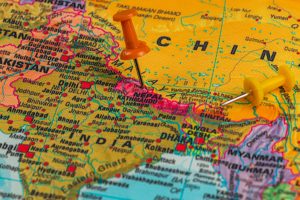
The long-standing India-Nepal dispute over Susta, one of the most geographically and politically sensitive sections of the Nepal-India border, erupted in violent clashes on August 2 between Nepali villagers and Indian border security personnel.
The latter had allegedly crossed into Nepali territory in Nawalparasi West and dismantled an under-construction embankment built by local residents to prevent flooding. Nepal’s Armed Police Force had to intervene to prevent further escalation.
According to Nepali media, a similar iincident happened in June, when India’s Border Security Force personnel entered an embankment construction site in Susta Municipality-5 and pressured workers to halt the project, which was part of ongoing efforts to provide protection for flood-prone settlements in the area. India is yet to respond officially to these allegations.
India and Nepal share a 1,800-km-long open border. Susta in southern Nepal and the Kalapani-Limpiyadhura-Lipulekh area to Nepal’s west are disputed.
With regard to the dispute over Susta, there are no boundary pillars along the 24-km stretch of this region, and India and Nepal rely on natural features such as rivers and trees to mark the boundary. The shifting course of the Gandak (also known as Narayani) river, the midstream of which formed the boundary under the Treaty of Sugauli of 1816, has further complicated the border problem here.
Citing official sources from Nepal’s Ministry of Foreign Affairs, a Nepali media publication reported that the Nepali Embassy in New Delhi raised Sunday’s clashes at Susta with India’s Ministry of External Affairs (MEA) immediately. India’s position, according to this source, was that since the area where the embankment was built is disputed, the construction violates the “status quo” maintained between the two countries. India’s MEA is yet to issue a comment on this incident.
Nepali parliamentarians, who raised the issue in the House of Representatives, denounced the Indian security forces’ alleged actions and demanded the Indian government conduct an investigation into the incident and engage in diplomatic dialogue to “immediately stop the encroachment and threats.”
Such incidents are not uncommon; unresolved boundary disputes and competing territorial claims do periodically create tensions.
The India-Nepal border issue has erupted to the fore from time to time. In 2020, Nepal’s parliament passed a constitutional amendment to include a new political map that depicted the disputed Kalapani-Limpiyadhura-Lipulekh region as part of Nepal’s sovereign territory, which India rejected. Previously, Nepal had objected to New Delhi showing these territories as part of the Indian state of Uttarakhand.
On May 3 this year, Nepal objected to India and China’s plan to conduct the 2026 Kailash Mansarovar Yatra and restart border trade via the Lipulekh Pass as it traverses the disputed territory. New Delhi dismissed these claims as “unjustified,” describing Kathmandu’s “unilateral artificial enlargement” of territorial claims as “untenable.” Despite Kathmandu’s objection, India and China have resumed bilateral trade through the pass.
While India and Nepal have settled almost 98 percent of their border, disputes over Susta and Kalapani have proven difficult to resolve.
Back in 2014, both sides agreed that the border issue would be resolved through the mechanism involving the Boundary Working Group (BWG) and foreign secretaries. While the BWG, deals with boundary issues, such as construction, restoration and repair of boundary pillars and other technical tasks, the dispute over demarcation of territory in Susta and Kalapani is dealt with at the foreign secretary level.
Notably, while the BWG has met several times — most recently in July 2025 — no dedicated meeting at the foreign secretary level as part of the boundary resolution mechanism has taken place in the past 12 years.
In August 2025, Indian Foreign Secretary Vikram Misri visited Nepal. However, the focus of the visit was on development cooperation. There was no mention of discussions on the border dispute in press statements released after Misri’s visit.
Similarly, following Nepali Foreign Minister Shisir Khanal’s visit to India in June this year, statements issued by the Nepal embassy in Delhi and India’s MEA made no reference to discussions on the boundary dispute or any border-related issues.
Nevertheless, beyond being a permanent political irritant in bilateral ties, the boundary dispute has not significantly derailed ties. Successful operational coordination between Indian security forces and their Nepali counterparts and strong bilateral ties across multiple domains spanning trade, development cooperation, civilizational links, etc., have largely averted border disputes from escalating into major diplomatic crises.
In fact, the exceptionally open nature of the border with minimal fencing on both sides — unlike India’s heavily militarized borders with Pakistan and China — is widely regarded as symbolic of the special relationship shared by the two countries.
The current status quo on the border privileges India, which has a strong security presence of security personnel to protect its borders.
However, the damage caused by the repeated flare-ups of the border dispute — which has even resulted in deaths on the Nepali side — percolates to the grassroots level, aggravating strong anti-India sentiments in Nepal. This bodes negatively for India’s influence in South Asia at large, which rests heavily on its close civilizational and people-to-people links with its smaller neighbors. More dangerously, it opens space for third countries such as China to exploit and build their political clout to challenge Indian dominance in the region.
The border dispute is unlikely to snowball into a geopolitical regional flashpoint due to the asymmetrical relationship between the two countries, given Nepal’s strong economic dependence on India and much smaller size. However, if New Delhi continues to stall and brush Kathmandu’s concerns under the rug, it is likely to cause damage to its interests and influence in the region, especially at a time when relations with other neighbors are in peril.
Political trust and diplomatic dialogue are the way forward. What is missing is a sense of urgency to resolve the dispute, especially from New Delhi. Nepal Prime Minister Balen Shah’s upcoming visit to India provides New Delhi with an opportunity to address long-standing issues and redefine its relationship with one of its closest neighbors.
Author
