

- 0
- 1,454 word

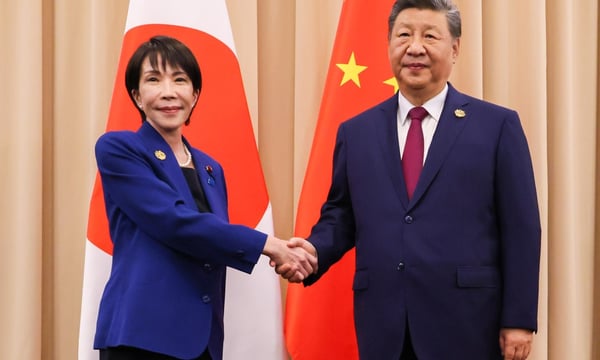
Japanese Prime Minister Takaichi Sanae (left) shakes hands with Chinese President Xi Jinping during a meeting on the sidelines of the APEC summit in Gyeongju, South Korea, Oct. 31, 2025.
Credit: Prime Minister’s Office of Japan
Japan’s relationship with the People’s Republic of China (PRC) began before formal diplomatic relations were established. Although diplomatic relations were not normalized until 1972, the two countries had already created an unofficial trade mechanism in 1962 that enabled bilateral trade despite the absence of mutual diplomatic recognition.
In a famous article published in Foreign Affairs in 1967, former U.S. Vice President Richard Nixon argued that “we simply cannot afford to leave China forever outside the family of nations.” At the time, Japan’s China policy had already been moving in that direction, going beyond even the policy imagination of its closest ally, the United States.
This was despite intense diplomatic pressure from the United States, which remained firmly anti-communist. Throughout the 1960s, Washington publicly opposed Japan’s efforts to normalize relations with one of its closest neighbors and discouraged any move toward diplomatic recognition of the PRC. The “shock” caused by Nixon’s announcement of his planned visit to mainland China in 1971 stemmed, in part, from Japanese frustration that this policy framework toward China – shaped and constrained by U.S. diplomatic pressure against Japan’s preference – was abruptly reversed without prior consultation with Tokyo.
After normalization, Japan and China entered a honeymoon period in which their relationship resembled a quasi-alliance, rooted in their shared distrust of the Soviet Union as a common adversary. This perception was also shared by the United States, which intensified its pressure against Moscow as Cold War tensions began to rise. From the late 1970s through the 1980s, Japan expanded its industrial assistance to China, while the United States strengthened military cooperation with Beijing, including transfers of military technology. These developments highlight the strategic importance that both Japan and the United States placed on their relationship with China.
A turning point in China-Japan relations came on June 4, 1989, when the People’s Liberation Army moved into Tiananmen Square to suppress student protesters. Images of the violence were broadcast around the world, prompting the U.S.-led Western bloc to impose sanctions in response to China’s violent crackdown.
Although Japan suspended its aid program to China, it was reluctant to fully participate in broader sanctions. It was Japan, at the critical G7 summit in Paris, that took the lead in preventing China’s complete isolation from the international community. Its efforts resulted in the inclusion of the following sentence in the summit declaration: “We look to the Chinese authorities to create conditions which will avoid their isolation and provide for a return to cooperation based upon the resumption of movement towards political and economic reform, and openness.” At that critical juncture, Japan was prepared to break with the emerging Western consensus in order to prevent China from being pushed back into international isolation.
The history reviewed above is essential for understanding the current state of China-Japan relations. Since the 1960s, the two nations have consistently maintained some level of economic exchange despite the political circumstances of each period. The characterization of their relationship as “hot economics and cold politics” has been a defining feature of bilateral ties, particularly over the past several decades. During the 1980s, and especially in the aftermath of the Tiananmen Incident, a strategic dimension also helped sustain the partnership, as both countries continued to view their relationship through the lens of shared geopolitical interests.
However, when examining the China-Japan relationship today, it may be more accurately described as one of “cooling economics and colder politics” – a trajectory that relations had not previously taken.
The turn of events can be traced back to Prime Minister Takaichi Sanae’s controversial statements in late 2025 hinting at the possible deployment of Japan’s Self-Defense Forces in the event of a crisis surrounding Taiwan. Some have argued that Takaichi’s remarks were bold and resolute, while others have criticized them as insensitive to China’s red lines and emblematic of her tendency toward gaffes. Regardless of the interpretation, what is clear is that Beijing was provoked by Takaichi’s statements and has sought to apply maximum pressure on Japan in response.
Even after Takaichi’s electoral victory in early 2026, China has continued to exert pressure on critical mineral supply chains and impose targeted export controls not only on Japanese defense firms but also on companies involved in dual-use technologies. The effects of China’s export controls on rare earths – a sector in which China possesses nearly 90 percent of global refining capacity – have already been felt by Japanese companies. Furthermore, the arrest of Japanese company employees in mainland China on allegations of illegally exporting rare earth magnets has further unsettled Japanese businesses that remain heavily reliant on the Chinese market.
At the same time, diplomatic relations remain stagnant, with a bilateral summit between Xi Jinping and Takaichi appearing unlikely in the near future.
While Japan remains open to a reset in its relationship with China, it appears to be gradually but decisively preparing for a future with reduced dependence on Beijing, reversing a decades-long trend of courting and nurturing its neighbor. This shift was represented in Takaichi’s “updated free and open Indo-Pacific” speech, in which she upheld the core principles inherited from her predecessors while also highlighting the importance of economic security and resilient supply chains with like-minded nations.
Although the country driving this necessity was not explicitly named, China’s ongoing economic pressure makes it difficult not to identify Beijing as the force behind this policy shift. This development may ultimately place limits on how broadly Japan’s strategic concept of a “free and open” Indo-Pacific can continue to accommodate China. However, at present, Japan appears to prioritize responding to geopolitical realities rather than attempting to sugarcoat them.
One theory explaining Japan’s shift in its approach toward China is generational change. The old China hands in Japan held a special sentiment toward mainland China. They were deeply aware that their generation, as well as that of their parents, had been connected to a period in which Japan inflicted immense suffering and destruction across China, as the Empire of Japan fully mobilized its military power from the late 1930s until the end of World War II. While they viewed investment in China as a commercial opportunity, they also regarded it as a means of addressing the wrongs committed by their nation and expressing gratitude for the PRC government’s decision to forgo war reparations.
However, the China hands who once held influential positions within the Liberal Democratic Party (LDP) are now aging and gradually exiting the political scene. They are being replaced by a younger generation of more hawkish conservatives who seek to hedge against China and deepen ties with Taiwan. It is striking that both Takaichi and Ishiba Shigeru visited Taiwan before becoming prime ministers – as if doing so had become a rite of passage for aspiring Japanese political leaders.
The reason why younger generations of politicians do not share the same perception of China as their predecessors may be attributed, in part, to their understanding of history. From their perspective, the historical debt has already been repaid, and their generation should not be expected to bear responsibility for the wrongdoings of the past, which occurred before they were born. The statements of prominent conservative politicians such as former Prime Minister Abe Shinzo and Takaichi are emblematic of this changing understanding of history. In a 2015 official government statement, Abe declared that “we must not leave our children, grandchildren, and generations to come, who bear no responsibility for that war, with the obligation to continue apologizing indefinitely.”
Similarly, back in 1994, the then up-and-coming Takaichi criticized Prime Minister Murayama Tomiichi, who would acknowledge and apologize for Japan’s wartime aggression against its neighbors the next year, arguing that “I do not think it is acceptable for someone to offer an apology on my behalf without my consent.” Whether this generational shift reflects a lack of historical awareness or a different interpretation of Japan’s wartime is unclear. Nevertheless, it is notable that both Abe and Takaichi have drawn particularly strong support from younger generations.
At certain points in history, Japan was among the few nations willing to engage with China despite international opposition, investing heavily without fully considering how such efforts might later be used against it. Today, with a fundamentally different relationship and balance of power between the two nations, Japan appears to be preparing for a new era. Today, the obligation to keep China integrated into the international community and maintain extensive economic ties regardless of the cost is no longer viewed as an imperative.
Author
