

- 0
- 659 words
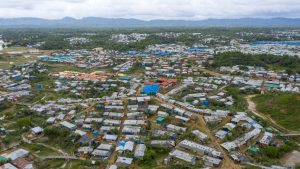
An aerial view of a refugee camp in Cox’s Bazar, Bangladesh.
Malaysia’s government said yesterday that it will not proceed with the planned repatriation of 5,000 Myanmar refugees if their lives are found to be at risk upon their return.
Deputy Foreign Minister Lukanisman Awang Sauni announced recently that around 5,000 Myanmar nationals currently in the immigration detention depot are set to be repatriated as soon as Myanmar is ready to accept them – a fact that Prime Minister Anwar Ibrahim confirmed on July 30.
“We have good relations with Myanmar. They have now agreed to take 5,000 Rohingya from Malaysia,” Anwar said during a campaign rally in Negeri Sembilan state.
Communications Minister Fahmi Fadzil told a press briefing yesterday that the country’s Ministry of Foreign Affairs and Ministry of Home Affairs are currently reviewing the plan to identify the 5,000 refugees to be returned to Myanmar,
“Malaysia, as a responsible country, will not return the 5,000 Myanmar refugees if they would either be persecuted or their lives would be threatened,” he said, as per Reuters, adding that there were “several matters” that needed to be discussed with the authorities in Myanmar.
“The Prime Minister has taken note that we cannot send them back if their lives are threatened,” he said. “So there are several matters currently being studied by the Foreign Ministry.”
The deportation plan follows a recent upsurge of xenophobic rhetoric and public hostility toward Rohingya Muslims, particularly online. In the past few months, prominent public figures have since described the Rohingya as “criminals” and “intruders” and likened them to a “cancer” on the country, while Rohingya refugee schools across the country have been forced to close due to harassment and threats. Late last month, more than 100 refugees were detained by the authorities after gathering outside the UNHCR building in Kuala Lumpur to seek assistance, after being evicted from their settlement in Penang state.
Rohingya asylum seekers have arrived in Malaysia steadily over the past two decades, and particularly since 2017, when an ethnic cleansing campaign by the Myanmar military pushed more than 740,000 from Rakhine State into Bangladesh. They were initially welcomed by their co-religionists, but public opinion has soured in recent years as the population has continued to grow.
Around 126,000 Rohingya asylum seekers are currently registered with the U.N. High Commissioner for Refugees (UNHCR) in Kuala Lumpur, around half of the agency’s total. However, Malaysia does not recognize the Rohingya as refugees, and as public sentiment has become more hostile, has tightened the enforcement of its immigration laws. Last month, Malaysia ordered UNHCR temporarily to stop registering new refugees in the country, so that it could begin operating its own system for managing asylum-seekers.
With third-country resettlement becoming more difficult, particularly due to the U.S. government’s new restrictions on refugee admissions, the most likely “solution” is repatriation to Myanmar.
But as human rights groups have pointed out, any proper investigation would conclude that there is little chance that the Rohingya will be able to return home safely. Myanmar’s military-backed government continues to view Rohingya as illegal Bengali immigrants from Bangladesh, and any assurances that it provides about the safety of returnees cannot be taken at face value. In any event, most of Rakhine State is now controlled by the Arakan Army (AA), a Rakhine nationalist group that has also been complicit in attacks on and mistreatment of Rohingya communities.
In a statement earlier this week, the advocacy group Human Rights Watch (HRW) called on Malaysia to suspend the repatriation, declaring that “conditions for safe, dignified, and voluntary return to Myanmar do not currently exist.”
“Malaysia has for many years hosted refugees from Myanmar who have fled unending oppression and atrocities by the Myanmar military,” HRW’s Bryony Lau said in the statement. “The Malaysian government should show regional leadership in responding to the crisis in Myanmar rather than forcibly returning people who are the targets of the junta’s brutality.”
Author
